
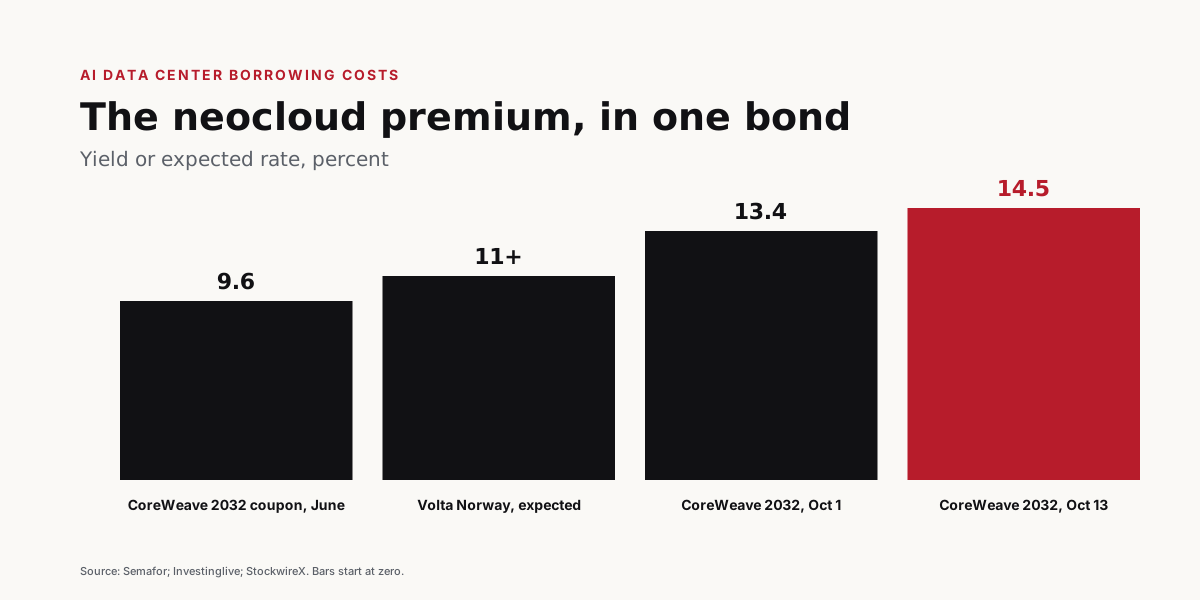
CoreWeave's notes due 2032 closed at a 14.5% yield on October 13, per Investinglive. CoreWeave sold them in June with a 9.625% coupon. The gap between those two numbers is the market's verdict on a lot of AI infrastructure debt this month. The money is still there. It now costs according to who the tenant is.
More than $450 billion of AI-related debt deals have been done this year, by Semafor's count, and Morgan Stanley says September was the second-slowest month of 2026 for AI financing issuance. The deals that close quickly have a rated tenant behind them. The rest pay up, wait, or pull the offering.
| Deal | Size | Price | Where it stands |
|---|---|---|---|
| Vantage campuses for Oracle, Texas and Wisconsin | about $38 billion of construction loans | about 2.5 points over the benchmark | took months to place with more than two dozen lenders |
| Volta, Norway, Anthropic as main tenant | $5 billion, plus a $1.3 billion term loan | at least 11% expected | Apollo anchored $1.5 billion |
| CoreWeave notes due 2032 | issued in June | about 14.5% yield, under 80 cents | rated B+ by S&P |
| Nscale IPO on the NYSE | seeking about $30 billion | some investors want $16 billion to $19 billion | roadshow waits on SEC comments |
| Firmus IPO in Australia | multibillion-dollar float | withdrawn October 9 | moving to private capital |
Start with the biggest. JPMorgan and Mitsubishi UFJ arranged about $38 billion for two Vantage Data Centers campuses tied to Oracle, $23.25 billion in Texas and $14.75 billion in Wisconsin. The package priced around 2.5 percentage points over the benchmark and took months to sell down, according to Bloomberg reporting summarized on Yahoo Finance. Banks including JPMorgan, MUFG, Morgan Stanley and SMBC have looked at moving slices of AI loan risk to outside investors because of internal limits on how much of it they can hold.
Volta is the clearest case of a lender pricing someone else's credit. The company was founded in February and is raising $5 billion for its first big project, a data center in Norway, Semafor reported. Apollo placed a $1.5 billion anchor order, and JPMorgan and Goldman Sachs underwrote a separate $1.3 billion term loan. The deal was expected to price at 11% or more.
Some investors said they were full on data center debt. Others objected to Volta's lack of a track record and to its reliance on Anthropic, which shares little financial information with lenders. The rate would fall if Anthropic won an investment-grade credit rating.
Lenders are pricing Anthropic, and Volta is the wrapper.
CoreWeave shows what happens once the market decides a borrower is the risk. Its 2032 notes yielded about 13.4% at the start of October and 14.5% on October 13, trading below 80 cents on the dollar. The shares fell about 15% on October 14 after a hot inflation reading. S&P rates the company B+, which is junk. Chief executive Mike Intrator called the selloff irrational.
Nscale is the equity version of the same question. It filed in September to list in New York and is seeking a valuation of about $30 billion. A group of investors told Bloomberg that $16 billion to $19 billion would be more likely to attract buyers, per The Next Web.
They pointed to Microsoft leaving a UK data center deal with Nscale after power delays, a flagship site in Norway running six months behind, and a $103 billion backlog of which only $2.6 billion comes from contracts already running. Nscale reported $140.6 million of revenue and a net loss of about $1 billion in the first half. We covered its West Virginia site, and the chestnut trees in its way, on October 12.
The investors also pointed to Firmus. The Australian builder withdrew its listing on October 9, saying the terms on offer "would not appropriately reflect" its business, per The New Daily. Its backers include Nvidia, Coatue, Blackstone and Jane Street.
What does a rate gap cost? Each percentage point on $5 billion is $50 million a year in interest. A builder paying 11% instead of an Oracle-style spread carries hundreds of millions a year more on a project that size, and that cost lands in the price of compute it sells to the labs. Our earlier look at Morgan Stanley's $570 billion AI debt estimate put the size of the borrowing ahead. October put a price on it.
Bottom Line
The cheapest money in AI infrastructure goes to whoever has a credit rating, and the labs know it. The Financial Times reported that Anthropic's and OpenAI's IPO advisers have been lobbying the rating agencies. Watch for the first investment-grade rating on an AI lab. It would reprice Volta and every deal built the same way in a single day.