
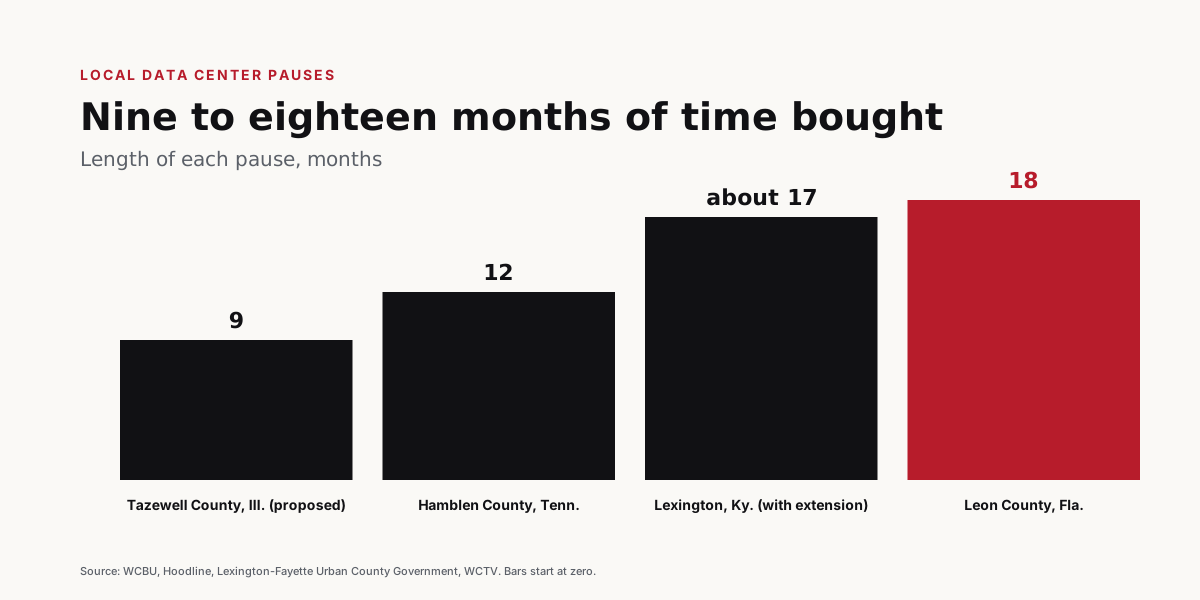
Volusia County, Florida voted 6-0 on October 20 to ban data centers with an anticipated peak load of 50 megawatts or more from its unincorporated areas, per Spectrum News 13. A week earlier, Leon County, home to Tallahassee, unanimously paused applications for "large-load customer facilities" for 18 months, per WCTV. Nobody from the public spoke at the final hearing. Those are two of at least six local governments that acted on data centers this month.
The rules differ in what they cover, and the difference matters to anyone siting a project. Volusia's ban applies to facilities above a power threshold and leaves its cities to set their own rules. Projects under 50 megawatts can still apply, and go through staff review, a zoning committee and a council vote. Leon's pause covers a category of electricity customer. It names no building type. Hamblen County, Tennessee went further down the same road with a one-year moratorium on any facility drawing 5 megawatts or more. Fewer of the new rules say "data center" than say "megawatts."
| Place | Action | Date | Vote | What it covers |
|---|---|---|---|---|
| Volusia County, Fla. | Ban | Oct 20 | 6-0 | Peak load of 50 MW or more, unincorporated areas only |
| Leon County, Fla. | 18-month pause | Oct 13 | Unanimous | Applications for large-load customer facilities |
| Fayette County (Lexington), Ky. | Pause extended | Oct 8 | 11-0 | Data center permits, plans and zone changes, until at least October 2027 |
| Tazewell County, Ill. | 9-month moratorium proposed | Board vote Oct 28 | Committee unanimous | New data centers, expansions and conversions in unincorporated areas |
| Kossuth County, Iowa | Moratorium process started | Oct 20 | 3-2 | Planning commission told to draft one |
| Morristown, Tenn. | Zoning rules | about Oct 20 | 6-1 | 500-foot setbacks from homes and schools, equipment indoors |
Lexington's council first adopted its pause unanimously on June 9 and extended it on October 8, per the city. A zoning text amendment that would remove "computer and data processing centers" as a principal use in several zones was scheduled for its second reading on October 22. A separate proposal would create a dedicated data center zone. The city's page also notes a data center planned in June at 745 West New Circle Road.
Tazewell County's moratorium would run to July 28 unless the board ends it sooner, and an early draft ordinance would allow data centers only in industrial zones, per WCBU. "People are so emotional about them," said Russ Crawford, who chairs the land use committee. The county says it will use the time to set standards for noise, lighting, water and energy use, backup power and decommissioning.
Iowa shows the other side. Kossuth County's supervisors split 3-2 on October 20 over whether to start a moratorium, per KLGA. The county's economic development director warned that "developers could be scared away." Three of the five seats are up on November 3.
Morristown chose rules over a pause. Its council passed setbacks of 500 feet from homes, schools and occupied government buildings and required all equipment to sit indoors, per Hoodline. The city has no applicant yet. Officials called the rules "precautionary rather than reactive."
What drives the votes? Water is the reason given most plainly. Volusia's chair said data centers "just don't work in Volusia County because of the way our aquifer is structured." Elsewhere the pauses are bought time, nine to eighteen months to write standards that didn't exist. That time runs into 2027 and 2028, the years many announced AI campuses are meant to come online.
The fights reach beyond the US. In Melbourne, a utility suspended grid work for a NextDC data center this month after local opposition and without council consent, which we covered on October 21. At the federal level, the Senate blocked a bill on data center power costs on October 1, as we reported. Trackers such as Siting Radar list dozens more local actions.
Bottom Line
For a data center developer, the binding approval is now a county board, and the rule it writes is likely to be a megawatt threshold. Check the load limits and the end dates of pauses in every county on a site shortlist, and treat any pause that runs past mid-2027 as a schedule risk for power you have already contracted.