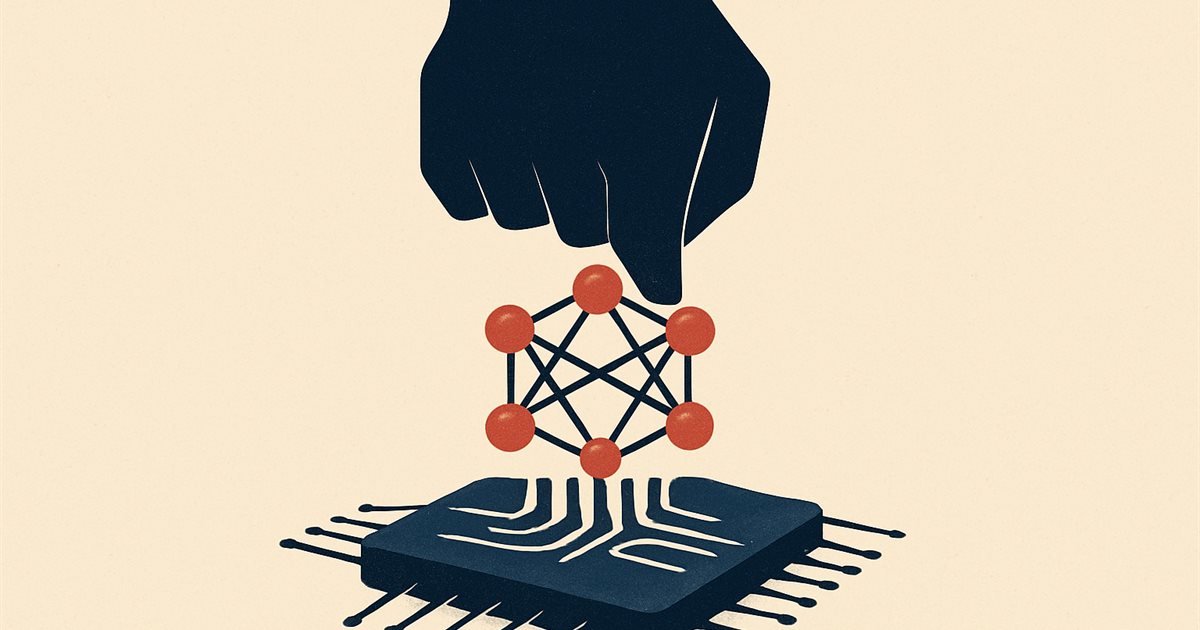
AMD agreed to acquire Taalas, a Toronto startup whose chips hardwire an AI model's weights permanently into transistors, per CNBC. Terms were not disclosed, and the deal is expected to close in the fourth quarter subject to approvals. Taalas had raised about $219 million, including a $169 million round in February. It claims 17,000 tokens per second on Llama 3.1 8B at roughly a tenth of the power an Nvidia H200 draws, per SiliconANGLE.
The mechanism is what makes this interesting. Every token a GPU generates requires reading the model's weights out of DRAM into the compute units, and that traffic sets the speed and power ceiling on inference, ahead of arithmetic. It is the reason HBM is scarce and expensive, and the reason memory pricing is currently inflating everyone's capex. Taalas removes the read entirely by turning the weights into circuitry, so the model stops being data the chip fetches and becomes part of the chip itself. If the numbers hold outside the lab, that sidesteps the memory wall.
The cost is total inflexibility. A chip with one model etched into it runs that model and nothing else, so a new release means new silicon. That is a strange thing for AMD to buy in a market where model versions turn over every few months, and it only pays if a handful of workloads become stable enough and high-volume enough to justify dedicated parts. AMD is buying an option on that future without betting the roadmap on it, which is the sensible way to hold this position. It also follows the Instinct MI400 launch and the Core Scientific capacity deal, so AMD is assembling an alternative to Nvidia at the chip, the software, and now the deployment layers at once.
Bottom Line
Hardwiring weights is the most aggressive answer yet to the memory wall, and it trades away every bit of flexibility to get there. Watch which specific models AMD chooses to cast in silicon, because that list is a bet on which workloads have stopped changing.