
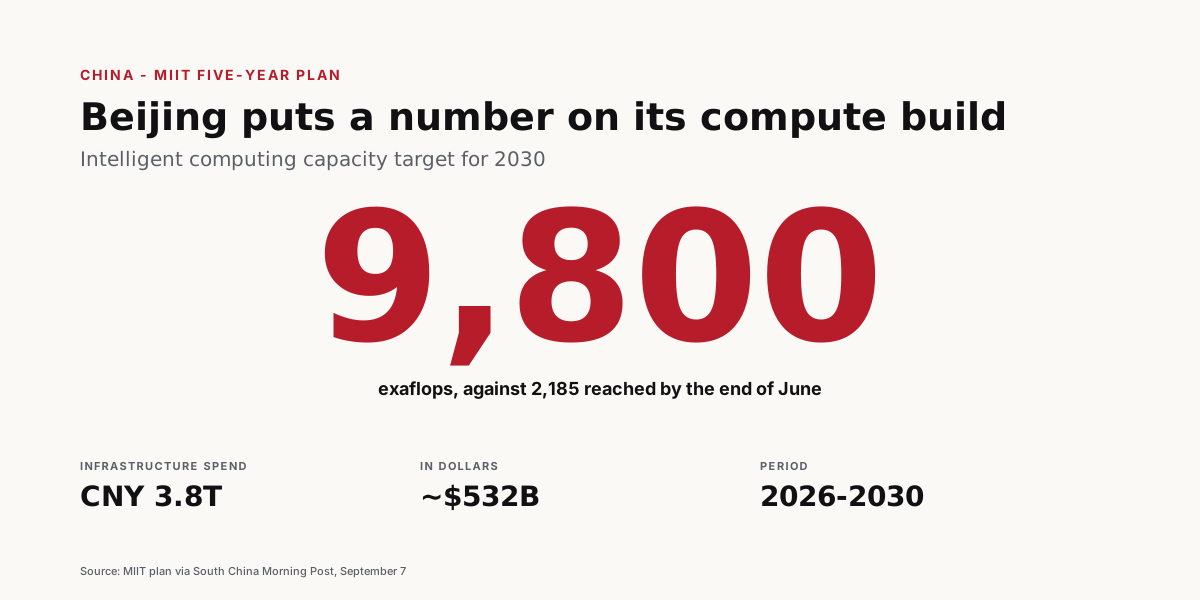
China's Ministry of Industry and Information Technology published the 15th Five-Year Plan for the information and communications industry, targeting 9,800 exaflops of intelligent computing capacity by 2030 and CNY 3.8 trillion, about $532 billion, in cumulative information infrastructure investment across 2026 to 2030, per the South China Morning Post. Capacity reached 2,185 exaflops at the end of June, up 177% year over year, across 52 facilities each holding more than 10,000 accelerator cards. The document was posted publicly on September 7 and is dated August 12.
The plan directs deployment of clusters at the 10,000-card and 100,000-card scale, alongside inference facilities tuned to specific applications. It is guidance for industry. Its figures are goals. Reaching 9,800 exaflops from 2,185 takes about 35% compound annual growth, against 177% last year, so Beijing has written a sharp deceleration into its own plan. The likeliest reason is silicon supply under export controls.
Ten-thousand-card and hundred-thousand-card clusters are training infrastructure, and they need exactly the high-end accelerators that controls restrict. Application-tuned inference capacity can run on older or domestic parts, and it is where economic returns show up. Funding both keeps frontier training possible if supply allows and keeps the deployed economy running either way.
Chinese compute is being planned as public infrastructure on a published schedule. American capacity is being built on private balance sheets against contracted demand. The first is exposed to policy changes and fabrication timelines, the second to a demand curve and GPU residual values, and neither has been tested through a downturn.
Bottom Line
The 2030 target implies about 35% compound growth from a base that just grew 177%, a plan built around a supply constraint. Watch the ratio of training clusters to inference facilities, since it is the clearest public signal of how much frontier silicon China expects to get.