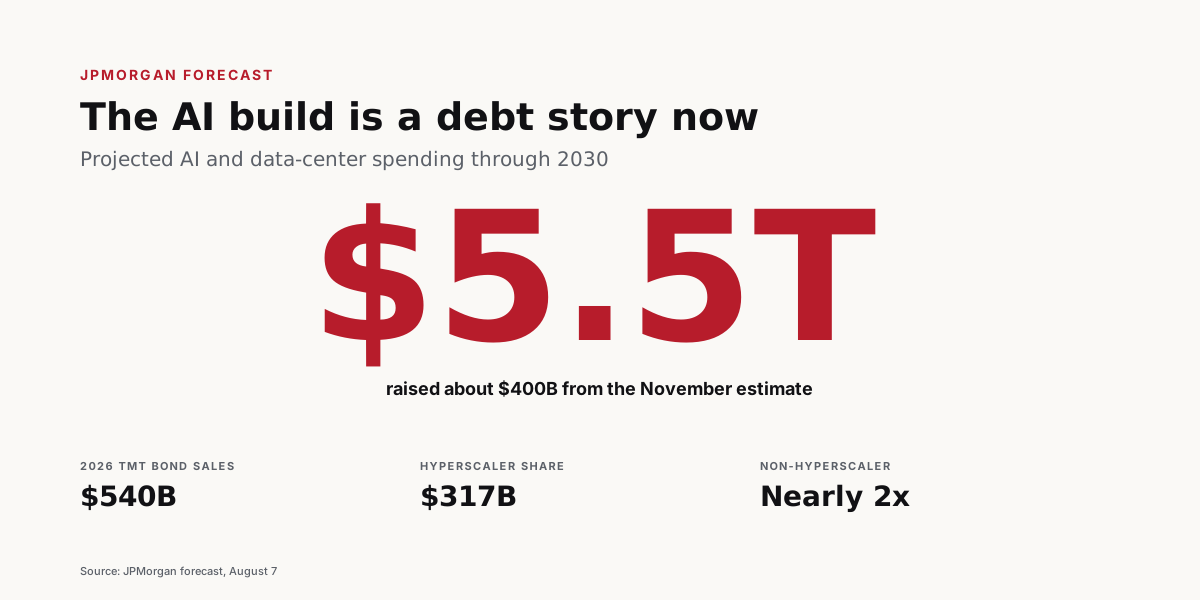
JPMorgan raised its forecast for 2026 technology, media, and telecom bond issuance to $540 billion from $450 billion, and now expects $5.5 trillion of AI and data-center spending through 2030, roughly $400 billion above its November estimate, per Bloomberg. It projects $2.1 trillion of data-center financing through high-grade bond markets over five years, up from $1.5 trillion. Hyperscalers account for $317 billion of this year's expected issuance, and the bank's strategists wrote that reliance on debt financing for AI investment will be a defining feature of the next several years.
The line to watch is the non-hyperscaler number, which JPMorgan nearly doubled from $78 billion to $146 billion. Hyperscaler borrowing is the comfortable part of this forecast, because Microsoft, Amazon, and Alphabet fund enormous capex against enormous cash flows and investment-grade balance sheets. Doubling the projection for everyone else means the debt is spreading to issuers with thinner coverage: neoclouds, data-center developers, and AI companies whose revenue is growing fast and whose profits are not.
Set that against the last two weeks and it resolves into one picture. Nvidia is in talks to guarantee $250 billion of OpenAI's Ohio project precisely because conventional lenders would not underwrite it alone. SpaceX spent $15.8 billion on AI infrastructure in a quarter with $7.8 billion of revenue. Amazon lifted capex to about $220 billion on memory prices. When Morgan Stanley pegged AI-linked debt near $570 billion for this year, that looked aggressive; JPMorgan's revision says the trajectory is steeper. The sensitivity nobody has tested is rates, because $2.1 trillion of high-grade issuance priced in a benign credit market refinances in one that may not be.
Bottom Line
The AI build is now underwritten by the bond market, and the fastest-growing slice of that borrowing sits with issuers who lack hyperscaler balance sheets. Watch credit spreads on data-center paper, because that is where this cycle would show strain first.