
Investors have approached OpenAI about a new funding round, per CNBC. The Financial Times and Bloomberg put the valuation above $1.2 trillion, and the New York Times reported $1.5 trillion, per 24/7 Wall St.. Talks are in early stages. OpenAI last completed a $122 billion round at an $852 billion post-money valuation, and it ran a roughly $7 billion employee share sale at that same mark in August, per CNBC.
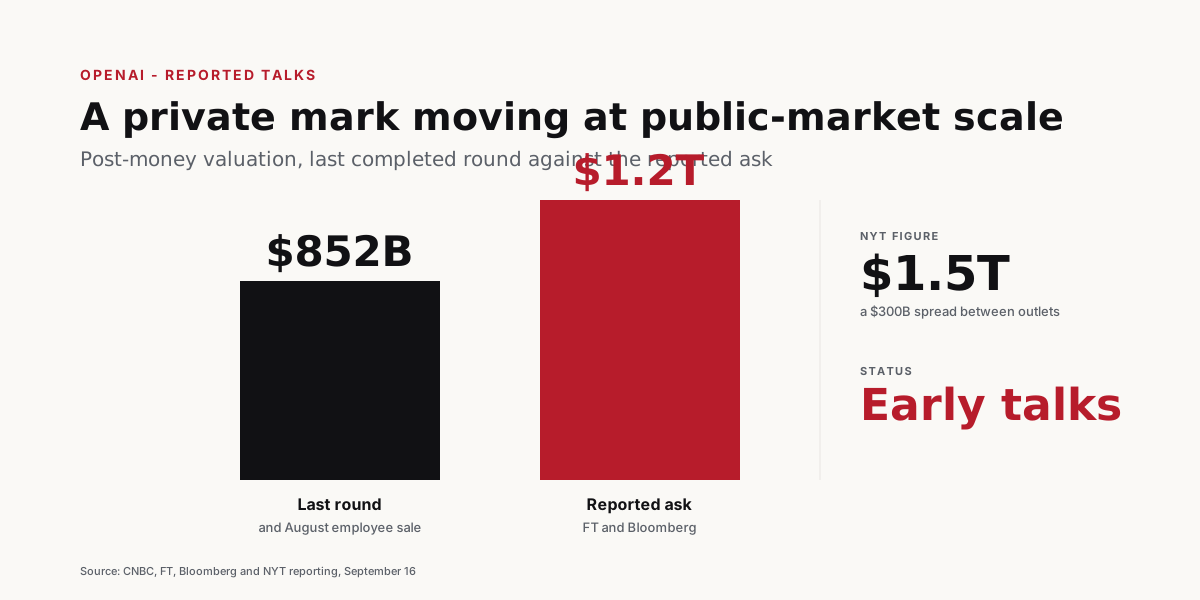
A $1.2 trillion mark is a 41% step-up from $852 billion in about five weeks, and the $1.5 trillion figure would be 76%. The $300 billion spread between outlets exceeds Procter & Gamble's market capitalization, and the likeliest explanation is one set of reports using pre-money and the other post-money. Until someone publishes terms, the range is a negotiating band.
The timing sits oddly against last Saturday. Sam Altman told Fortune on September 12 that going public in 2026 would be an "ill-advised moment" given safety concerns, and four days later investors are pitching a private round at public-market scale. Both positions hold together. Private capital lets OpenAI set a mark with a handful of counterparties, with no quarterly disclosure and no daily price against it. The cost is that employees and early backers need company-run sales for liquidity, and reporting frames the proposed round partly as a way for employees to sell stock.
Bottom Line
A 41% step-up five weeks after the last mark, with a $300 billion spread between outlets, is a negotiation happening in public. Wait for terms before treating $1.2 trillion as a price, and watch whether employee liquidity turns out to be the real driver.