Microsoft AI said on October 15 that it has finished pre-training MAI-Base-2, per Microsoft. It is a mixture-of-experts model with 2.8 trillion total parameters and 80 billion active per token. The model is now in post-training. Microsoft gave no release date or price.
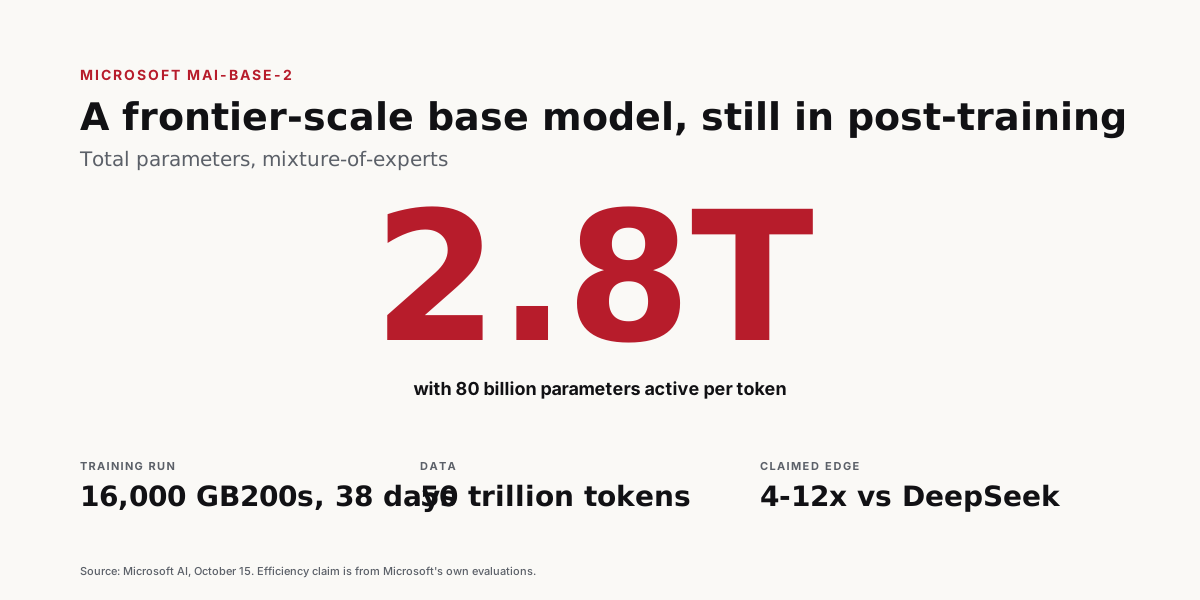
The run used 16,000 Nvidia GB200 GPUs for 38 days in August and September, at 21% average model FLOPs utilization. The data mix was 50 trillion tokens with a March 2026 knowledge cutoff, and 18% of it was vision-language data. Microsoft says every token was processed in-house, with no distillation from other companies' models.
The main claim is efficiency. Microsoft says MAI-Base-2 is 4.2 to 12.3 times more pre-training FLOPs-efficient than DeepSeek-V4-Pro-Base, which it calls the strongest open base model. The measure is bits per byte on four held-out tests, fitted to scaling curves to estimate the compute needed to match DeepSeek. One test set is Microsoft's own code. Vendors built the other three. No outside group has replicated the result.
The release plan points at enterprises. Microsoft says it will "license our model weights to trusted partners through Foundry," with no timeline or partner list. It trained on Nvidia hardware. Its own Maia 300 chip is not due in racks until 2027, which we covered on October 12. Microsoft already sells OpenAI and Anthropic models through Foundry, and a base model of its own gives it a third option to price against them.
Bottom Line
Microsoft now has a frontier-scale base model of its own, and the evidence so far is its own benchmark math. If you buy models through Foundry, ask what licensed MAI weights would let you run on your own infrastructure, and at what price. Wait for post-trained results before planning around it.