Microsoft announced Maia 300 on October 12, the third generation of its in-house AI accelerator, per Microsoft. Production deployments begin in 2027. The company says it will scale the Maia family to multi-gigawatt deployments from that year and make it "the primary inference system for Microsoft products and services."
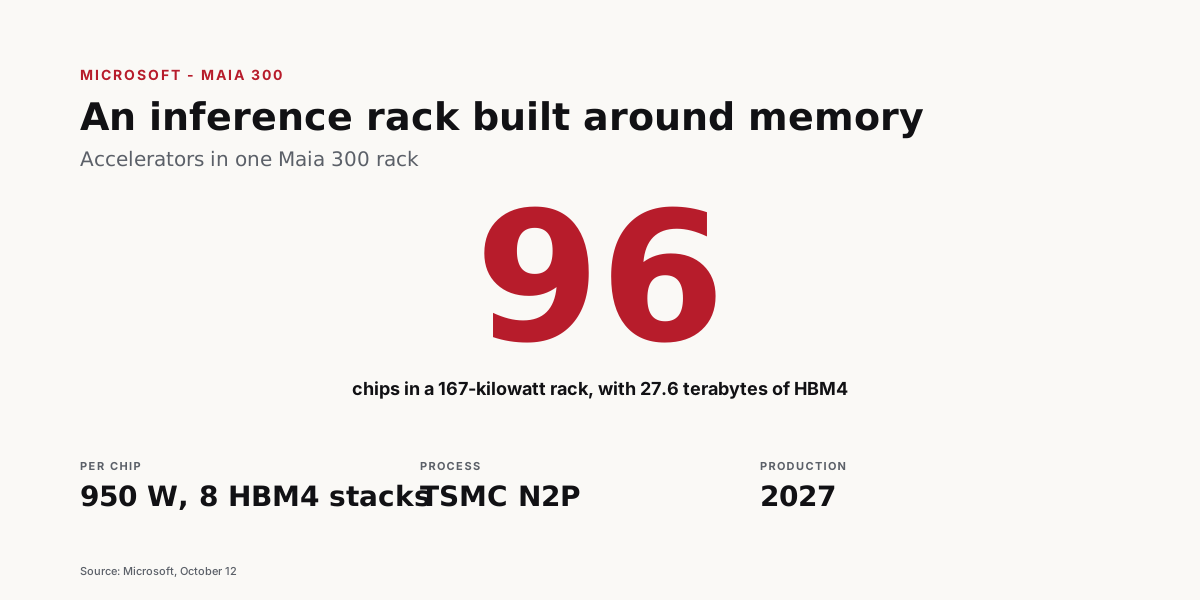
The compute chiplets are built on TSMC's N2P node, and each accelerator carries eight HBM4 stacks with 18.0 terabytes per second of peak memory bandwidth at a 950-watt power draw. A rack holds 96 accelerators in a 167-kilowatt envelope, with 27.6 terabytes of HBM. That works out to about 288 gigabytes per chip. Maia 200, launched in January, had 216 gigabytes of HBM3e and drew 750 watts, per Unite.AI.
Microsoft calls the design inference-first. It targets long-context, memory-heavy work and multi-step agent tasks, which is why the memory numbers lead the announcement. The company claims up to 40% more tokens per megawatt than "leading GPU-based systems" and up to 7 times the rack-level token throughput of Maia 200. It names no GPU as the baseline. Nobody outside Microsoft has tested the chip.
The planned workloads are Microsoft's own: Copilot, GitHub Copilot, Foundry model serving, and its MAI models. The post does not say whether customers can rent Maia directly, and it does not address training hardware. Each Maia 300 takes eight HBM4 stacks at a time when Micron says most of its 2027 high-bandwidth memory is already contracted, as we reported.
Bottom Line
Microsoft is moving its own inference onto its own silicon, starting in 2027, at 96 chips and 167 kilowatts a rack. If you buy Azure AI services, expect pricing and capacity to depend less on GPU supply over time. If you sell into data centers, plan for racks that draw 167 kilowatts and for another large buyer of HBM4.