
Mistral raised EUR 3 billion in a Series D at a post-money valuation above EUR 21 billion, roughly $24 billion, which the company calls the largest equity round ever completed by a European technology firm. Samsung Electronics led with about EUR 1 billion, co-led by the EU-backed Scaleup Europe Fund managed by EQT and existing investor PSG Equity, with Advent, BlackRock-managed funds, and the Grand Duchy of Luxembourg joining, per CNBC. ASML led the Series C a year ago at EUR 11.7 billion, so the mark nearly doubled.
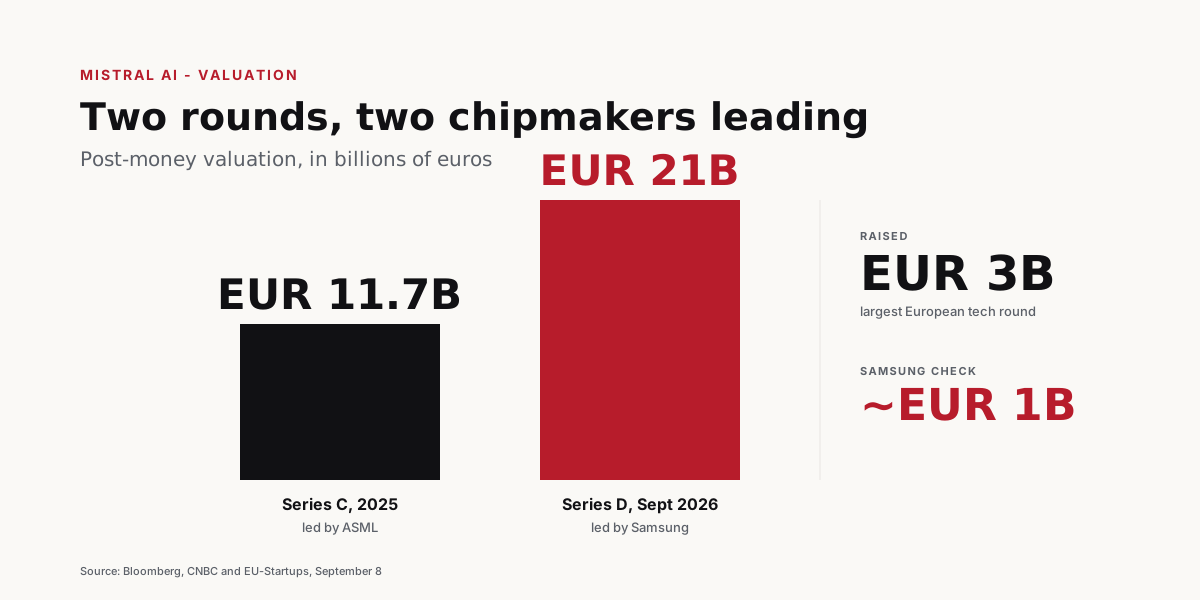
Two rounds, two chipmakers in the lead chair. A lithography monopolist, then a memory maker. At the top of the market, Microsoft, Amazon, and Google hold both the equity and the compute contracts of the labs they back. A chipmaker sells into a lab without becoming its landlord, so Mistral's cap table leaves it answerable to no cloud provider's roadmap or capacity allocation.
Arthur Mensch told CNBC the money goes into building and owning data centers, renting capacity in the meantime, with owned compute growing about 100% over five years and a long-term goal of running entirely on self-built capacity. Mistral already committed EUR 1.2 billion to a 23-megawatt facility in Borlange, Sweden with EcoDataCenter, online in 2027. It targets 200 megawatts across Europe by the end of that year and a gigawatt by 2030.
Anthropic just committed about $45 billion over six years to lease 460 megawatts from Nscale. Mistral is raising equity to own. Leasing turns capex into contracted opex and gets capacity sooner; owning costs more upfront and keeps the asset and its residual on your own balance sheet. European sovereignty rules make locally owned infrastructure a sales argument for Mistral. The risk is a lab with a fraction of OpenAI's revenue taking the most capital-hungry strategy available.
Bottom Line
Mistral is using equity to buy independence from the landlord tier just as its larger rivals sign decade-length leases, so track its megawatts closer than its euros. Whether that proves disciplined or overreaching depends on GPU residual values nobody has tested.