
CoreWeave's revenue rose to $3.66 billion in the third quarter from $1.37 billion a year earlier, per its earnings release, but its net interest expense of $846 million was four times its operating income of $207 million. It lost $709 million.
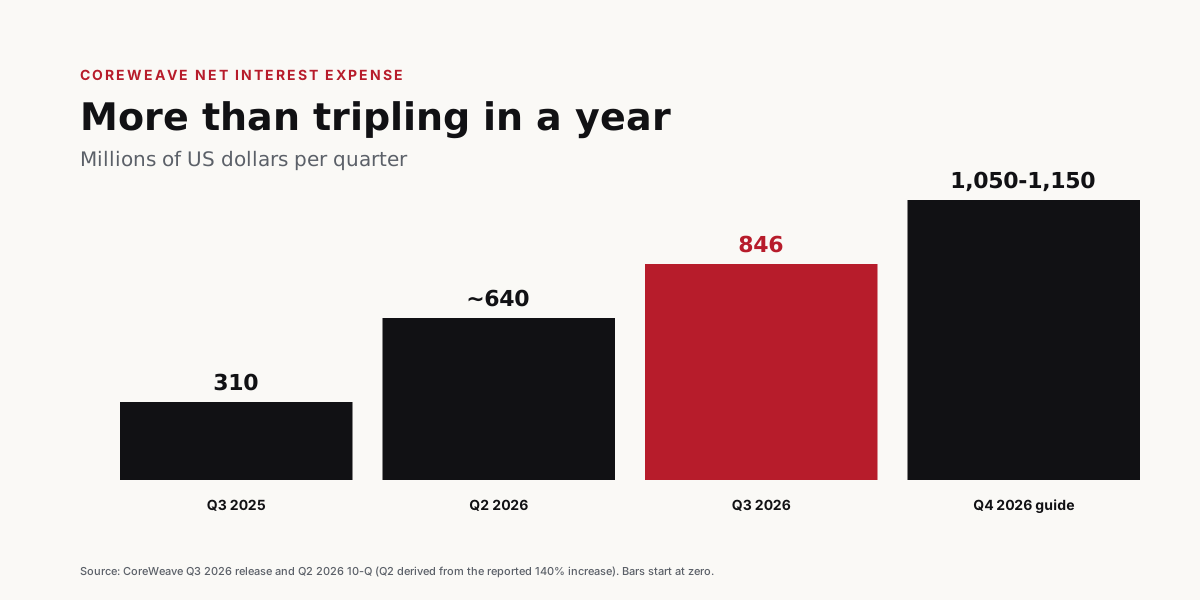
Net interest was $310 million a year earlier and about $640 million in the second quarter, based on the 140% increase CoreWeave reported in its second-quarter filing. The company expects $1.05 billion to $1.15 billion in the fourth quarter.
As a share of revenue, though, interest has held steady. It took about 23% of revenue in the third quarter, the same as a year earlier. Revenue and the interest bill are growing at roughly the same pace, which is the point of borrowing against signed contracts. The open question is whether that holds as rates on new debt reset and older, cheaper money runs out.
| Third quarter, millions | 2025 | 2026 |
|---|---|---|
| Revenue | $1,365 | $3,661 |
| Adjusted EBITDA | $838 | $2,256 |
| Adjusted operating income | $217 | $379 |
| Operating income | $52 | $207 |
| Interest expense, net | $310 | $846 |
| Net loss | $110 | $709 |
The gap between those lines is the business model. Adjusted EBITDA of $2.26 billion covers interest about 2.7 times. Adjusted operating income, which subtracts mostly depreciation on the GPUs and data center gear CoreWeave buys with borrowed money, was $379 million, well short of the interest bill. That hardware wears out in years while some of the debt runs to 2032.
CoreWeave had about $46.9 billion of debt on September 30, per its third-quarter 10-Q, filed November 12, up from $35.1 billion three months earlier. Of that, $41.6 billion is backed by the parent company and $5.3 billion sits in subsidiaries with recourse limited to their own assets. At June 30 the effective rates on its delayed-draw term loans ran from 9% to 15%, its senior notes about 10%, and its equipment financing 9% to 11%. Its convertible notes cost about 2%. Cash was $4.1 billion.
Since June it has added more. The release lists about $4.2 billion of new convertible notes, an at-the-market program to sell up to 35 million shares, and a $2.6 billion loan facility built for shorter customer contracts. The bond market was already charging CoreWeave about 14.5% on its 2032 notes in mid-October, as we reported.
Customers are now a funding source too. Chief executive Michael Intrator said the company expects "approximately $9 billion in customer prepayments and deposits" in the next three months alone. Deferred revenue was already $9.7 billion on June 30. Revenue backlog stood at $132.5 billion on September 30. Prepayments matter because they are cash that carries no interest, and every dollar a customer pays up front is a dollar CoreWeave does not have to borrow at 9% or more.
Concentration has eased but not gone away. In the third quarter its two largest customers made up 30% and 24% of revenue, the 10-Q shows, against 67% for the single largest a year earlier. The filing does not name them.
The build-out keeps accelerating. CoreWeave raised its 2026 revenue forecast to $13.0 billion to $13.3 billion and expects $37 billion to $39 billion of capital spending. Active power passed 1.7 gigawatts, contracted power passed 4.6 gigawatts, and it expects to exit the year at an annualized revenue rate of $20 billion to $21 billion.
The comparison with its customers' borrowing is stark. Microsoft pays about 5% to 6% on its new bonds and Meta about 6% to 7.5%, as we laid out on November 9. CoreWeave borrows at roughly twice those rates to build capacity it rents to companies like them.
Bottom Line
CoreWeave earns enough before depreciation to cover its interest, and not enough after it. Its fourth-quarter interest bill of more than $1 billion has to fall behind revenue growth for the model to work, so read the next quarter's operating income against that line first.