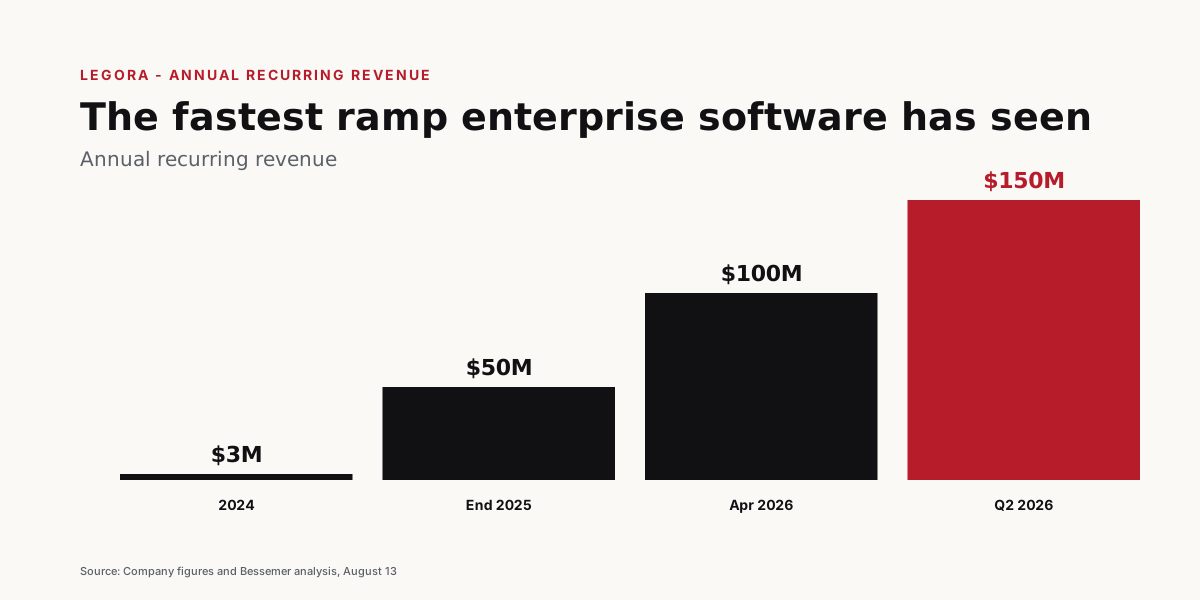
Harvey is in advanced talks to raise at least $500 million at a $15.5 billion valuation, five months after investors marked the four-year-old company at $11 billion, per TechStartups. It reports more than $350 million in annualized revenue, roughly $300 million of it recurring, up from $190 million ARR at the start of the year. Rival Legora is seeking funding above $10 billion four months after a $5.6 billion round, with ARR up 50% to $150 million in the second quarter, per Lawyer Monthly.
Look at the cadence on these cap tables. Harvey added roughly 40% to its mark in five months and Legora nearly doubled in four, which means neither round is being priced off a stable comparable. Investors are underwriting a growth rate, with the multiple following it. Legora's ramp explains why: about $3 million in ARR two years ago, $50 million at the end of 2025, $100 million in April, $150 million by the second quarter. Bessemer clocked that run to $100 million as the fastest any enterprise software company has managed, ahead of OpenAI, Anthropic, Cursor, and Wiz.
Legal is where this was always most likely to land first. The billable work that consumes junior lawyers, document review, research, and first-draft production, is text in and text out, the exact shape these models handle best. Law firms also price by the hour against fixed matter budgets, so any tool that compresses hours converts directly into margin the firm keeps. That produces contracted, expanding revenue, well past seat experiments.
Watch the math investors are accepting. Harvey at $15.5 billion on roughly $300 million of recurring revenue is near 50 times ARR, and Legora at $10 billion on $150 million is closer to 65 times. Both need years of compounding at current rates to grow into those marks, in a single vertical where two well-funded competitors are now positioned to outspend each other for the same firms.
Bottom Line
Legal AI produced the fastest revenue ramp enterprise software has recorded, and the valuations have run ahead of even that. Watch net revenue retention at both companies, because in a two-horse vertical the winner is decided by expansion inside existing firms.