
Anthropic's draft prospectus shows $16.3 billion of revenue in the first half of 2026, up from $1.1 billion a year earlier, and a net loss of $80.7 billion, according to The Wall Street Journal's reporting on the document as summarized by The Next Web. The draft is not public. Anthropic declined to comment, and the filing it eventually makes can differ.
About $72 billion of that loss is an accounting charge. No cash left the company for it. The charge comes from the rising value of convertible notes and other instruments Anthropic used to raise money. As the company's valuation climbs, what it owes those holders is worth more on paper, and the increase runs through the income statement. Take the charge out and about $8.7 billion is left, which the reported draft does not break into operating loss or cash burn. For anyone pricing the IPO, that charge is a preview of dilution, because those notes turn into shares at listing.
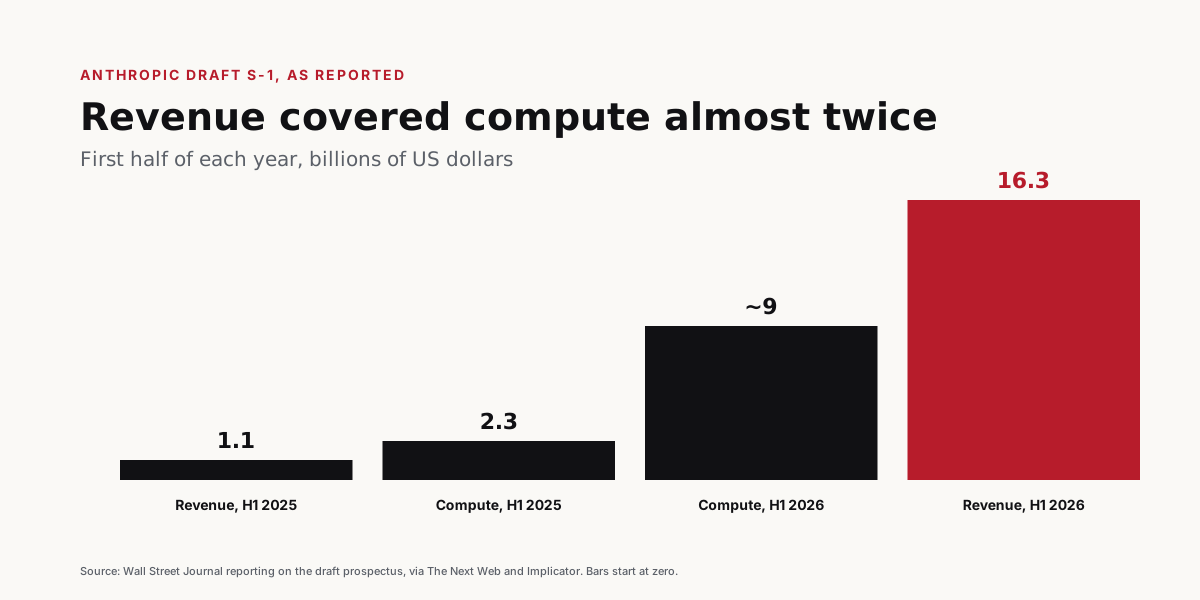
The operating business is easier to read. Anthropic spent nearly $9 billion on computing capacity and infrastructure in the first half, against $2.3 billion a year earlier and $7.3 billion in all of 2025. Revenue covered that line almost twice. The company separately told investors that third-quarter revenue was $16.8 billion, up about 45% from the second quarter, per Implicator. That implies second-quarter revenue of roughly $11.6 billion. One quarter now brings in about what the whole first half did.
Then the commitments.
| Commitment | Amount, as reported | Terms |
|---|---|---|
| Google Cloud | $111 billion | part of about $450 billion of cloud deals over 7 to 10 years, mostly non-cancelable |
| Amazon Web Services | $110 billion | same |
| Microsoft | $31 billion | same |
| Nvidia chips rented from Nscale and Lambda | up to $86 billion | through 2033 and 2034 |
| Google chips through Broadcom equipment leases | more than $160 billion | lease obligations |
| Total | more than $600 billion | up to $150 billion more under negotiation |
Most of it can't be cancelled. Anthropic owes those amounts whether or not demand keeps growing, and the chip rentals through Nscale and Lambda run seven to eight years from now. A slowdown in revenue would not shrink the bill.
Set against $16.8 billion of quarterly revenue, $600 billion is about nine years of revenue at the current rate, before any growth. The bet is that revenue keeps compounding faster than the commitments come due.
The risk factors say where it can go wrong. The draft says Anthropic has sought more compute than its cloud partners would provide, and that those partners increasingly see it as a competitor. Some third-party data center operators it relies on have limited operating histories, and their facilities may be less reliable than the big clouds'. That is the same credit question lenders raised on the Volta deal in Norway, which we laid out on October 19. The draft also warns that damages from a catastrophic AI incident could exceed what insurance covers, and Bloomberg reported that it describes model behavior resembling "blackmail" and "self-preserving" tendencies.
Concentration is the quieter number. About one-fifth of first-half revenue came from two customers the draft does not name. That is roughly $3.3 billion between them in six months.
On timing, Bloomberg reported that marketing could start as soon as the week of November 9, with trading before Thanksgiving. The Journal reported Anthropic is seeking a valuation of about $2 trillion, and Reuters reported some investors are weighing about $1.5 trillion. At $2 trillion, buyers would pay about 30 times the current revenue run rate of roughly $67 billion a year. The listing comes with the 5% public benefit fund Anthropic announced on Sunday, which we covered, and Broadcom's agreement to lend up to $42 billion for chips, reported earlier this month.
Bottom Line
When the public S-1 lands, read two things first: cash burn, which the reported draft leaves out, and the conversion terms on the notes behind the $72 billion charge. Together they decide how much of a $2 trillion valuation actually reaches people who buy at the IPO.